Overview
How CommsCrew works.
A guided tour of every user journey in the product, with real screenshots from the live build and honest notes about what's not yet implemented.
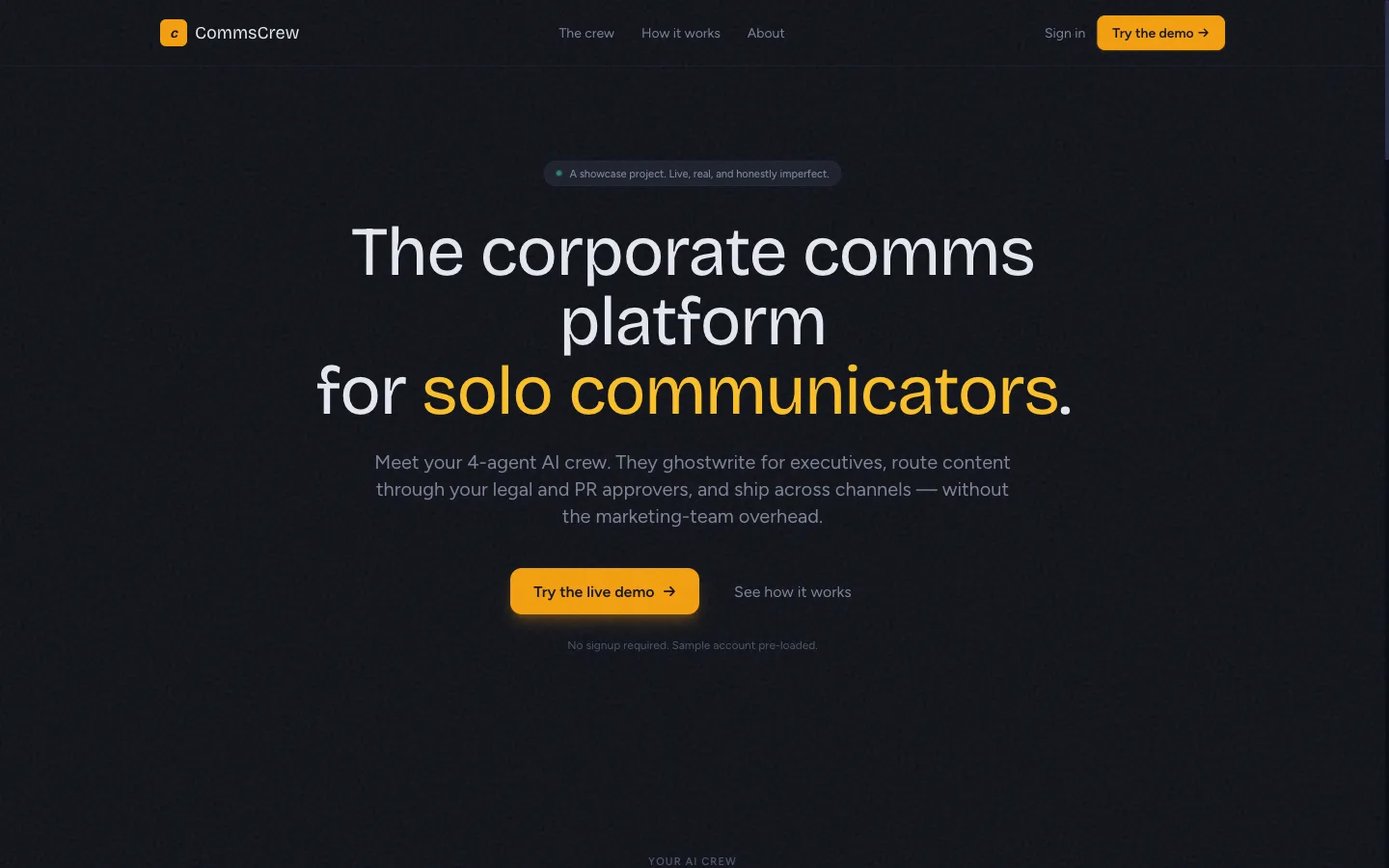
What this product is
A four-agent AI system for solo corporate communicators and small teams. The agents — Strategist, Writer, Editor, and Analyst — collaborate on a single pipeline: brief → draft → score → save. From there you edit, route to approvers, schedule, and (eventually) publish.
The whole product runs at <$10/month on AWS, deployed via a single EC2 spot instance + Neon serverless Postgres + Caddy auto-TLS. The build methodology is documented in the Builder’s Playbook.
How to read these docs
- Each section is a complete user journey, beginning to end, with screenshots inline.
- Every section ends with a red Honest limitations box — what doesn’t work, what’s stubbed, what we know is broken.
- Open the demo in a separate tab — the credentials are pre-populated. Click around as you read.
The journeys
Getting started →
From landing page to your first crew message in under 90 seconds.
Creating content →
How a brief turns into three brand-voice-scored variants via SSE streaming.
Editing & approving →
Variant selection, send for review, the approval queue.
Scheduling →
Schedule modal, calendar grid, status transitions.
Memory & learning →
Brand voice profile, org facts, exec ghostwriting, edit-signal learning.
Limitations →
Complete list of what's stubbed, broken, or deliberately deferred.
Honest limitations
The whole product is a deliberately scoped showcase. The most important things to know about before you read further:
- Multi-agent is mostly UX framing. Under the hood it’s three sequential Claude calls (Strategist → Writer → Editor) with text passing between them. No autonomous agent behavior.
- Publishing is demo-only. Demo OAuth, demo post URLs, and seeded engagement metrics work; real LinkedIn / Twitter OAuth + post APIs are not wired.
- Billing is stubbed. Stripe is wired in the model layer but no real payment flow.
- Semantic memory is real, but the score isn’t a confidence. Retrieval is genuine cosine similarity over embeddings (recall@5 0.87 on a labelled corpus, against 0.28 for the keyword search it replaced). What it still can’t do is abstain: a query with no answer scores 0.54 against 0.47 for irrelevant documents.
- Variant body parsing has a known bug. Currently extracts the “Craft Notes” section instead of the actual body (Issue #4 from the lessons-learned deck).
Next
Getting started →
Sign in, the first-login walkthrough, and the dashboard you land on.